The Building Site
From the Blackdown Hills web-site www.blackdown-hills.net
Quoted with the permission of the Blackdown Hills AONB
A Legacy of Distinctive Buildings
* The area contain's many traditional buildings of special architectural or historic merit, many of which are designated listed buildings. The majority of buildings consist of the simple, distinctive farmhouse, which adds much character to the area.
* Traditional buildings have a functional simplicity, built from locally materials to serve the needs of the agricultural community.
* Some Georgian, Victorian and Edwardian buildings constructed of brick and stone are found in larger villages or in isolated locations.
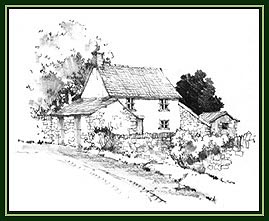
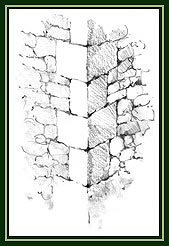
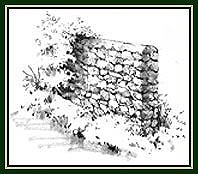
* Traditional building materials reflect the local geology. Chert, sourced from the plateau tops, is used widely. Cob is more common in western areas where chert is less readily available. Both cob and chert buildings are often rendered to improve resistance to damp. Render was traditionally lime washed, sometimes with pigment added for a pale cream of pink colour. Limestone, mainly found in the form of honey coloured Hamstone is found in the eastern areas, used for quoins and mullions. Upper Greensand is also used for these purposes. Thatched roofs are still found, the local style being a flush ridge and simple rounded eaves, but slates, pantiles and occasionally plain tiles are now more common as roofing materials . Steeply pitche, gable end roof structures are the most common roof form in the Blackdown Hills.
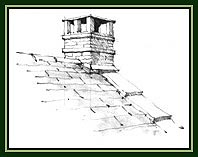
* Traditional houses have a simple form, generally being rectangular in plan, one room deep, perhaps with a lean-to extension or wing added to the rear at a later date. They are usually two storeys high, often with the upper floor taking up some roof space, which causes the small first floor windows to be set just beneath the eaves. Chimneys are usually at the gable end. The front door may be protected by a small porch. Windows are small and often made of wood, although wrought iron windows may still be found. Side hung casemnet windows with multi-paned frames are characteristic of old buildings in the area. Bricks are used for quoins, door frames and window frames where limestone is not locally available.
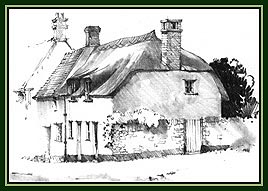
* Windows and doors are traditionally painted, wood stains being a modern material.
* The most distinctive relationship of buildings to roads is for them to have their gable end on to the road. Building and boundary walls tend to front roads directly rather than being set back beyond a wall.
* Where houses have gardens, these are often enclosed by chert walls with simple wooden gates.