 The Building Site
Cob
From "Down the Deep Lanes"
by Peter Beacham (with photographs by James Ravilious), Devon Books, 2000.
Each cob wall can truly be called unique because it will represent the fusion of a very localised building material - soil that has been dug from the site where it was to be used - with the local technique for building with it, one of the clearest expressions of a vernacular tradition anywhere in England. And that uniqueness will be enhanced by time. Protected by a stone plinth below and, originally at least, a generous eaves overhang above, unrendered cob will show in its rounded corners and deepened surface textures its conversation with the local weather that began on the day it was built. On such weather-beaten surfaces the low light of morning or evening plays delightfully to show up the constituent materials: soil, shillet and straw, a landscape in miniature, a vertical ploughed field, inviting to the eye and to the touch. Similarly, although thousands of cob buildings are disguised behind a coat of lime render, the render was repeatedly lime washed, producing a patina with ageing that when caught by slanting light seems to shimmer with the undulations of the centuries.
'Earth to earth' is the phrase that often comes to mind when contemplating the unison of cob and its landscape, so deep-rooted and natural is the relationship. And nothing so perfectly expresses this as the colours of cob: deep reds, rich ochres and yellows, pale creams, warm browns and even cold greys, they endure in the memory of landscapes otherwise only half-remembered. It is because cob walls hold the earth in common with their fields and therefore the buildings change colour with the soils that they seem to belong more effortlessly to their landscapes than even the most perfect stone-built houses. And the colours are always changing, subtly responding to local conditions even in areas of apparently uniform soils. Sometimes the changes are striking, especially where the complicated geology of the south west collides with itself to produce dramatic contrasts of soils within the space of a few miles. The best place to see this is in Devon to the north and west of Crediton where red and yellow cob intermingles throughout that deep, lost countryside.
Only a few years ago cob was tottering gently into an esoteric section of English provincial history but recently it has experienced an unexpected renaissance. Cob is now found on the agenda of planning committees and its construction and repair are the subject of student dissertations, research projects, conferences and even television documentaries. Pamphlets are available, learned articles continue to be written, and at least one hard-back handbook has been published. Even better, new cob buildings are being constructed in Devon: first the now locally celebrated bus shelter at Down St Mary and more recently extensions to existing buildings and completely new houses. And it seems only yesterday that building societies magisterially refused mortgages on cob buildings because they were self-evidently little better than peasant hovels liable to return to mud as soon as the rainy season started.
There are some nice ironies here. Each new age has a natural and understandable tendency to discard tradition because of the promise of the new, but how did we come to lose centuries of building tradition so suddenly and almost irreversibly? The process by which cob building has had to be rediscovered has been a salutary corrective to the notion that late twentieth-century technology and expertise can solve everything, especially something as primitive as building a mud wall. As with so much that disappears before its true value has been appreciated, cob has proved humblingly resistant to slick reinvention: instead it has had to be learned laboriously all over again by making the same mistakes it took previous generations centuries to overcome.
Picture:
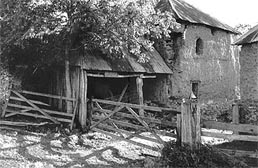
Cob barns, Broomham, Kings Nympton (Devon) by James Ravilious
You can read Peter Beacham's essay on Corrugated Iron
on the CORRUGATED IRON CLUB web-site
 Derbyshire Detail and Character

