 Orchards, Trees & Orchard Produce
Leicestershire information
Orchards, Trees & Orchard Produce
Leicestershire information
Ashby Parva Nurseries, Ashby Parva, Lutterworth, +44(0)1455 209225 is a family run nursery that grows all its own stock. Stocks a range of fruit trees, including apple varieties and will try to source varieties that they don’t stock, on request.
We are still researching the orchards, produce, nurseries and recipes of Leicestershire. Can you help? Please let us know if you are aware of local orchards, varieties, or dishes, good products and the places that sell them : email info [at] commonground.org.uk
Orchards and Community Orchards to visit
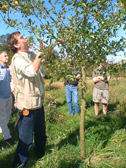 Brocks Hill Community Orchard (left, photo with permission from John Bristow), near the Visitor Centre, Brocks Hill Country Park, Washbrook Lane, Oadby. Approximately 172 fruit trees, apples, pears, plums, cherries and cobnuts, were planted in January 2001 within Brocks Hill Country Park. Every tree was sponsored, mostly by local people and details are recorded in an Acknowledgement Book available for viewing in the visitor centre. Apple varieties chosen were Allington Pippin, Brownlees Russet, Annie Elizabeth, Lord Derby, Dumellers Seedling, Barnack Beauty, Golden Pippin, George Cave, Newton Wonder, Cox’s Pomona, Tom Putt. Also the pears Durondeau, Clapps Favourite, Conference and Beurre Hardy, and plums Early Rivers, Pershore Yellow Egg, Cambridge Gage, damsons and Elton Heart Cherry. Many of the varieties are from the midlands. Several other apples and pears were planted before records were kept and are still to be identified. During the first five years the orchard was kept weeded but as the trees have developed sufficiently to support themselves, management is focusing upon creating a traditionally managed orchard. The trees are pruned annually to maintain good, vigorous growth and fruit production. The grassland is managed as a hay meadow, with a cut taken late summer/early autumn and all cuttings removed to prevent nutrient enrichment and retain floristic diversity. The wildflower meadow provides a valuable source of nectar and larval food-plants to support many species of insect and the retained hedges are also a valuable habitat for wildlife. Early insects, such as bees benefit from the blossom, fieldfare and redwing eat the fallen fruit in winter and butterflies benefit from the late source of nectar. A family of foxes is seen regularly playing in the area, song thrushes have nested in the hedge along the orchard boundary and blackbirds, robins, wrens and dunnocks use the fruit trees as song posts. Apple Day is celebrated annually with Leciestershire varieties to taste and buy and pruning advice given in the orchard with one of the tree wardens. The Country Park and orchard have full access at all times though the visitor centre is only open during the day. Contact: John Bristow,Brocks Hill Visitor Centre, Washbrook Lane, Oadby, Leics LE2 5JJ, +44(0)116 257 2888, brockshill[at]oadby-wigston.gov.uk
Donington le Heath Manor House Orchard, Manor Road, Donington le Heath, Coalville. A small orchard of 0.1ha planted on a lawned area next to formal historic gardens at Donington le Heath Manor House, owned by Leicestershire County Council. The orchard is managed by the Country Parks Service and the Friends of Donington le heath Manor. Semi dwarfing trees were planted of apples, pear, medlar, filberts, gages and prunes of local and historic varieties. The fruit is used for Apple Day each year and used by the restaurant. There are also nature days, craft events, a bat walk and bird watching events in the orchard. The surrounding area is managed for wild life with native trees, ponds, wader scrapes, wildflower meadow, established mixed hedgerows and bird and bat boxes. Open daily 11am-4pm, closed 20 December- 6 January, and weekends only through January. Contact: Cath Pilling, Snibston Discovery Park, Ashby Road, Coalville LE67 3LN, cpilling[at]leics.gov.uk
Hose Community Orchard, Canal Lane, Hose, Melton Mowbray (22m northwest of the village along Canal Lane). An orchard of a quarter of an acre planted in 2000-2001 on abandoned allotments by the Hose Community Orchard Association. The Parish Council who own the land, continue to mow the grass, and volunteers prune the trees and maintain the orchard. Half standard trees of apples, pears, plums, nuts, medlar and quince are surrounded by hedgerow and fence. There is an emphasis on local varieties. More hedgerow plants and wildflowers have been planted to increase biodiversity. Contact: Ian F Smith, Glenn House, 15 The Green, Hose, Leics LE14 4JP, +44(0)1949 860707, ifhose[at]f25.com, www.hosevillage.org.uk
The Walled Garden Nanpantan, off Nanpantan Road (B5350) and Woodhouse Lane, Loughborough. A small old orchard in an Edwardian walled garden in Loughborough, restored by a local conservation group, the Nanpantan Walled Garden Co-operative from 1999. It was once part of a large country estate and is now owned by the School of Economic Science, leased to the Co-op. A £48,000 Heritage Lottery Grant helped the group get expert advise and reconstructing the greenhouse and buildings within the walled garden. As well as practical tasks there is a history group actively researching the history of the garden to help inform its restoration. The orchard of about half a hectare, was very overgrown before restoration and is thought to be about 100 years. Some trees have been added. Around Apple Day juice from the orchard is sold at a farmers’ market in Castle Donington, with the press brought along to encourage participation. Access is limited to weekends. Contact: Mike Hamilton, Gorse Covert Community Centre, Maxwell Drive, Loughborough LE11 4RZ, +44(0)1509 743752, gorsecovert[at]aol.com
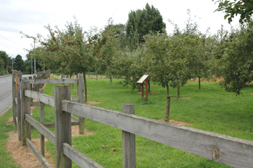 Ratby Community Orchard (left), Taverner Drive, off Station Road, Ratby, Leicester. A half acre community orchard on the edge of Ratby village, planted in 1998 by the Ratby Community Orchard Group. The land was gifted to the Parish Council by a developer and is surrounded by a housing estate and floodplain. The orchard was planted with standard apple trees plus pear, quince and medlar including local apple varieties Annie Elizabeth, Barnack Orange, Blenheim Orange and St Ailred, also Ellison’s Orange from neighbouring Lincolnshire. The apples are picked by members of the group and scrumped. Some are saved for Apple Day. A survey identified a wide range of flora and fauna, a pond has been dug, hedges augmented and bird and bat boxes installed. A totem pole carved from a tree from the nearby wood stands in the orchard, its designs taken from the drawings of animals made by local school children. It is topped with a crow, the symbol of Ratby. As the orchard matures, group membership and interest is slowly growing. As well as Apple Day there is wassailing, maintenance days and a Wildlife Safari event. Contact: Steve Boud, 3 Ingle drive, Ratby, Leicester LE6 0NN, +44(0)116 239 4873, Stephen.boud[at]btinternet.com
Shackerstone Village. Dumelow’s Seedling was raised in Shackerstone in about 1800 by a local farmer Richard Dummeller who died in 1816 and is buried in the village churchyard. A villager Brian Saunders heard a local radio gardening programme mention the apple and found that it had been virtually lost in the area. The village resident’s association felt it would be fitting to bring the apple back to the village in time for the Millennium. So in October 1999, to coincide with Apple Day, ten Dumelow’s Seedling trees from Deacon’s Nursery on the Isle of Wight were planted around the village. Some old apple trees in the village will be identified to see if they are descendents of the original tree. A millennium mug was made and given to each child in the village with the inscription from Mr Dummeller’s gravestone “Praises on tombs, they are but vainly spent, a man’s own deeds are his best monument”. Contact: Mrs. M. Cullen, Clerk to Shackerstone Parish Council, Temple Mill, Gibbet Lane, Bilstone, Nuneaton, Warks. CV13 6LT, +44(0)1827 880724
