 The Building Site
From the Blackdown Hills web-site www.blackdown-hills.net
Quoted with the permission of the Blackdown Hills AONB
Distinctive Settlement Forms
The Blackdown Hills' settlement have a deeply rooted relationship with the landscape. They are constructed of materials found locally and their shape is influenced by the local landform. Settlements are rural in character with views out into the surrounding countryside.
* Farmsteads, hamlets and villages are scattered throughout the area but are mainly located in sheltered valleys and on hillsides away from exposed hilltops and plateau.
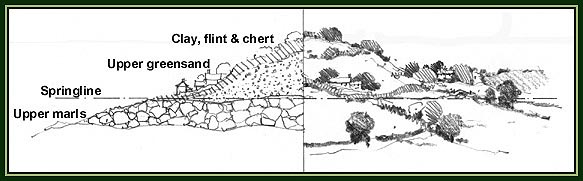
A simplified geological cross-section through a Blackdown Hill
* Many buildings and settlements are located above the marshy springlines of the upper valley side. The springlines occur when water percolates through the upper greensand and emerges as springs where it meets the impermeable clays beneath.
* The larger villages, such as Hemyock, are located in the bottom of the valleys, often at a river crossing or crossroads.
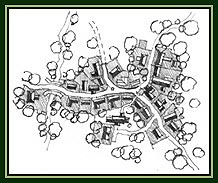
* Many villages within the valleys have a nucleated form with an obvious centre in the form of a crossroads, church or a village green, for example, Churchinford, Stockland and Hemyock. The existence of a focal point to a village gives it a distinctive character.
* Villages that have developed along roads or springlines tend to be linear in form. Those along springlines have a strong horizontal appearance in the landscape, following the lines of roads down the valley sides.
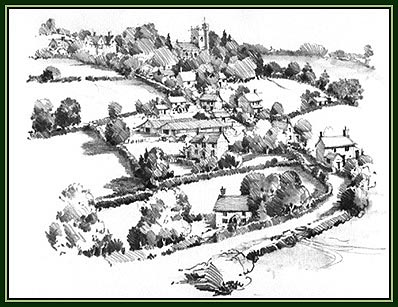
* The core of a village is usually the oldest part, with a dense collection of traditional buildings. Towards the perimeter buildings become more widely spaced and younger.
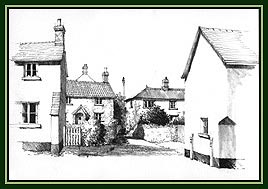
* Traditional settlements have a human, intimate scale. Roads are narrow and defined by buildings with low eaves and small windows, often with gable ends facing the road.
* A mix of building styles and materials is common in most settlements, united by the use of chert and a similarity in the form and detailing of buildings.
Read more about the AONB ...
 A Legacy of Distinctive Buildings

