 The Building Site
The Small and Unsung : Beach Huts
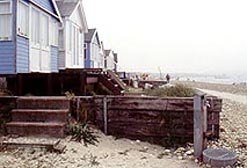
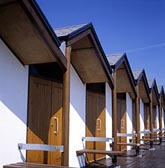
"The prudish nature of Victorian bathing has left us a colourful legacy the beach hut is descended from the wheeled bathing machines from which daringly clad men and women descended to dip in the sea.
Now along parts of the coast rag tag gatherings of railway carriages, boats that have 'dunsailin', fishing huts and shacks link the land and the sea, Cumbria and Cornwall, Essex and Dorset (Left: Mudeford) all have their beach hut fraternities. They bring twinges of jealousy to those who pass the domestic-yet-free family scenes with cups of tea and deckchairs, snoozing magazine readers and liberated tots with buckets and spades.
The first leisure hut is reputed to have appeared on Mudeford Sandbank (Dorset, by Christchurch) circa 1918, simple shelters at first they soon sprouted enclosed verandahs. By 1931 there were a hundred, temporary at first but later became established with permission to sleep in them about that year. Proper public toilets and a water supply arrived a few years later! In front of the huts, the vertical elements of the verandahs were a reason in the 1940s (?) for the council to charge a square footage fee for the space enclosed. So everyone cut off the vertical enclosures and called them simply platforms. Attempts in the 70s to charge for these resulted in a deal - huts are allowed 6 foot x width of hut i.e. usually 60 square feet free of excess charges. Now the vertical elements have re-appeared for the beach 'aristocracy' at least."
Personal communication 22/8/02 from Tim Baber editor, Mudeford Sandbank News, Hengistbury Head Times and the Christchurch Harbour Chronicle.
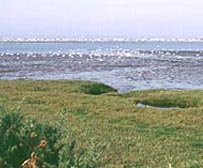
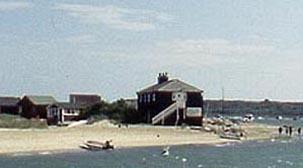
Tim's family have owned the hut for more than 50 years; it is well equipped - 'A small solar-panel fitted on the asphalt roof, provides enough power to run some mood lights and a sound-system'. It stands amongst 350 others making a variegated splash of colour and a zig zag of roofs along the sand spit from Hengistbury Head to the Run, the narrow mouth of the joint catchments of the Stour and Avon. The Spit gives the beach huts a dual outlook, inland over the expansive area of Christchurch Harbour and seaward over the shipping forecast area of Portland, towards the Needles and the Channel.
Along with the fishermans sheds, the community focuses around the beach and the café, and since people have the rare privilege of being able to sleep in their beach huts through March - November, this is a lively place.
Many ranks of beach huts are now municipally owned and standardised, always in demand for hire for the summer or by the day. Where individually owned, rigidity of plot size and restrictive bylaws has nevertheless fed the imaginations of the owners. The variety and richness of decks and shutters, gable ends and roof lines, stilts and and varnish makes for seaside splendour even in the rain. Some of these now change hands for £65,000 even where the threat of rising sea levels is almost palpable.
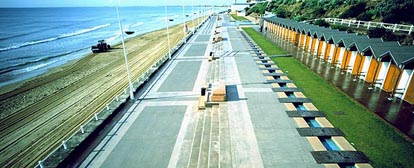
In Lowestoft and Bridlington new lines of beach huts have been built in the last few years. The East Riding of Yorkshire retained Bauman Lyons Architects to refurbish Bridlington's South Foreshore Promenade (right and below). Working with Bruce McLean, artist, they have created a new café, shops, staircases, boat slipways, playground, paddling pool, viewing terrace and beach huts, linked by the mile long promenade. Solar heated shower, water channels and sculptures add new dimensions to the seaside atmosphere.
Bauman Lyons also created six landmark bus shelters for Bradford
Read more about Mudeford beach-huts on the Sandbanks News web-site
New beach huts can be seen on the web-site for CABE (The Commission for Architecture and the Built Environment) and you can read their profile of the South Foreshore Promenade in Brislington here.
Pictures by Common Ground except:
Top left and 3rd row: Bridlington South Foreshore Promenade, Martin Peters for Bauman Lyon Architects.


