 Richard Cox
and
Richard Cox
and the Cox's Orange Pippin
Richard Cox
and
the
Cox's Orange Pippin
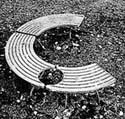
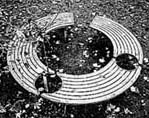
On Apple Day (October 21st) 1992, twenty nine apple trees - mainly Cox's Orange Pippin, two Blenheim Oranges, a Cox's Pomona and Ribston Pippin were planted by forty children from Colnbrook Combined and Poyle County First schools in a quarter acre parcel of land south of Albany Park. This land was named 'Pippins Park' by the Poyle Residents' Association in 1986 because of its proximity to Richard Cox's garden and the original tree.
In amongst the trees, and in fact protecting them in some instances, three specially commissioned metal seats form the letters C O X. these were designed by Common Ground and blacksmith sculptor Richard Farrington - who made them. The seats themselves contain information about Richard Cox, the Cox's Orange Pippin and Colnbrook which is stamped in them.
The idea for the orchard and seats came from arts/environment group Common Ground who work for the conservation of old orchards and for the 6,000 varieties of apples that we can grow in this country. Common Ground sought the assistance of the Colne Valley Park Groundwork Trust to help the idea come to fruition. The Trust mounted exhibitions and worked closely with the two schools, local people, prepared the ground and organised the tree planting and installation of the seats.
Colnbrook Combined and Poyle County First schools celebrate their new Community Orchard and the installation of three seats by Richard Farrington in memory of Richard Cox and the Cox's Orange Pippin on Apple Day 1992. Photo: Jeff Pick.
Albany Park is owned by the Borough of Spelthorne (now part of Slough Borough Council) who kindly gave permission for a small part of it to become an orchard again for as recently as 1935 this area was an orchard - two old apple trees still survive in the hedge.
The Borough of Spelthorne have agreed to cut the grass and to mow the paths under a management plan devised with the Colne Valley Park Groundwork Trust. The informal meadow feel of the orchard will be maintained. Primroses, cowslips and ox-eye daisies were planted by the school children amongst the trees. We hope that local people will be involved in the long-term caring of the orchard - by watering the young trees in dry spells, looking after the wild life and distributing the fruit or leaving it for the birds.
As the main purpose of the Community Orchard is for the enjoyment of the people and wild life, fruit production can be a secondary consideration, in which case the trees will not need much pruning. Most of the trees in the orchard are half-standards - trees grafted on to less vigorous rootstock - which means they should reach a height of about 18 to 20 feet.
